Revolution Throwing

The INSIDE90β„’
Throwing System

A simple system for building a healthy, efficient, repeatable throw.

Build the path.   Power the path.   Let it go.

The foundation

Get
INSIDE90β„’

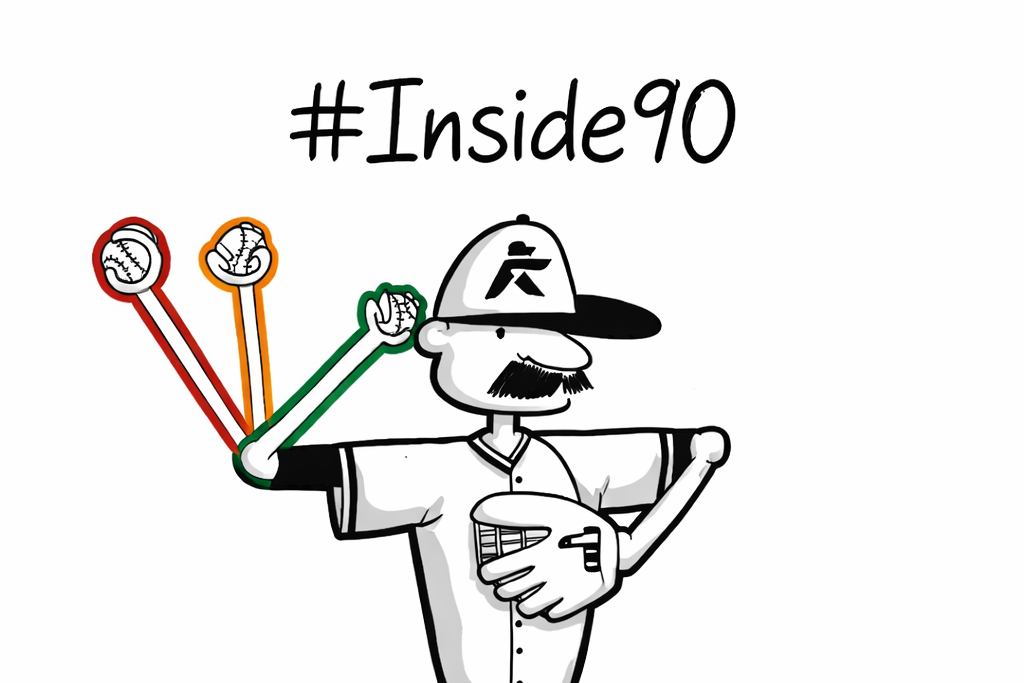
At the center of our throwing system is one simple concept: get the throwing arm INSIDE90β„’.

As the arm move up and signals the body to rotate, we want the hand and ball working inward toward the head rather than pushing away from the body.

  • Arm is bent INSIDE90.
  • Hand above the shoulder.
  • Ball works inward.
  • Torso begins to rotate.

INSIDE90β„’ is not about freezing an athlete in one perfect position. It is about creating an efficent path for the arm to move through.

INSIDE90 arm path
Arcs, Circles & The Transfer of Energy

Why INSIDE90β„’ Works

Throwing is a transfer of energy.

As the body moves, energy has to travel through the system and ultimately into the ball. To master movement is to master that transfer.

And to master that transfer, the body has to move through arcs and circles.

The way a thrower transfers energy through the joints is one sign of an efficient, powerful throwing pattern. The joints don't simply move from one position to another β€” they coil and uncoil, helping the body gain, transfer, and release energy through one connected sequence.

Think of it like wringing out a wet towel.

You coil back to store energy.
You uncoil forward to release it.

In the throwing arm, the shoulder coils into external rotation before uncoiling into internal rotation. The forearm also moves through its own rotational sequence, transitioning from supination toward pronation as the arm accelerates and continues through the finish.

These movements aren't isolated.

They are connected arcs and circles working together as energy travels through the body, through the joints, through the arm, and ultimately into the ball.

The joints are critical transition points. When movement becomes disconnected, energy can be lost through those transitions and additional stress may be placed on the system.

INSIDE90β„’ is the start of organizing that sequence.

Instead of forcing the ball forward with a push, the athlete learns to move the arm through a path that allows the joints to coil, transfer, and release energy through continuous arcs and circles.

COIL β†’ TRANSFER β†’ RELEASE
The three arcs

Load. Rev. Accelerate.

01

LOAD

Prepare the arm to move.

As the ball leaves the glove, the throwing arm begins its path upward. The back of the throwing hand and fingers work inward as the arm rises toward the ear and back of the head.

Get the arm up and moving inward.

02

REV

Turn the body. Whip the arm.

As the hand and ball work inward and behind the head, the thrower feels the whip, the signal to begin rotating the torso, begining to power the ball while the bent arm transitions smoothly into the next phase.

The torso is the engine. The arm is the whip.

03

ACCELERATE

Take the throw through the target.

Once the arm moves through the Rev, the torso drives the acceleration of the hand through arm extension, pulling down through the finish and powering the ball forward.

Pull through the finish. Execute the target.

LOAD β†’ REV β†’ ACCELERATE
Our top-down approach

Arm path
first.

Build the arm path.
Then power the path.

Before asking an athlete to rotate harder, move faster, or create more force, we want the arm traveling through a path capable of handling that force.

First: arm up, hand inward, INSIDE90β„’, powering the Rev, connected acceleration.

Then: add drive leg, lead leg, lead arm, momentum, direction, and intent.

Self-organizing movement

Feel the Rev.

Athletes should learn to recognize their own movement. When the throw is connected, it tends to feel smooth, easy, rhythmic, continuous, and whippy. When it breaks down, it often feels hard, tight, sticky, segmented, or forced.

CONNECTEDSmoothEasyRhythmicContinuousWhippy
DISCONNECTEDHardTightStickySegmentedForced
How athletes learn

The drill is the instructionβ„’

We design movements and training tools that give the athlete immediate feedback. If the movement flows, the athlete can feel it. If it breaks down, the athlete can feel that too. Over time, the athlete begins to make self adjustments correcting the movement pattern themselves.

The progression

Build it in layers.

1

Load Up + INSIDE90

Start with getting the arm up and INSIDE90β„’.

2

Power the Rev

Bring the hand inward, add torso rotation, and connect the engine to the whip.

3

Connect the Arcs

Load. Rev. Accelerate. Start slowly, build rhythm, then build speed.

4

Add the Athlete

Layer in natural tempo, momentum, athleticism, intent, and throwing environment.

Movement before velocity

How well
can you move?

Velocity matters, but we want it built on movement the athlete can repeat. Establish the path first. Add intent progressively. Let speed emerge from a connected throw.

THE INSIDE90β„’ CHECK
  • Did the arm get up?
  • Is the hand working inward?
  • Is the athlete INSIDE90β„’?
  • Did the athlete feel the Rev?
  • Did the athlete stay loose or tense up too early?
  • Can the athlete accelerate smoothly through the throw?
The goal

Not a robotic throw.

An athletic, connected, repeatable throw that feels good.

The goal is not to make every athlete look the same. The goal is to give every athlete a movement framework from which their own throw can develop.

Train the system

The Rev Throw

The Rev Throw is an arm-path trainer designed to help athletes experience the INSIDE90β„’ Throwing System through rhythmic, repeatable movement.

The Rev Throw doesn't replace throwing. It helps athletes learn how to throw.

Rev Throw product

The Rev Throw

Train the INSIDE90β„’ Throwing System with the Rev Throw.

Shop Rev Throw

Everyone has a healthy throw.

We're here to help you find yours.

LOAD  β€’  REV  β€’  ACCELERATE